How to open a shoe shop: sizes, colours and stock
How to open a shoe shop: plan the size run, pairs, exchanges and season sales, then see how SellyPOS handles sizes, colours, stock and returns.
Short answer To open a shoe shop, plan the size run for each style, the colours, the pairs you hold and the rule for exchanges. Count each size and colour by pair, and decide how a returned pair goes back on the shelf. SellyPOS starts a shoe shop with its size and colour options, in Basic and Professional.
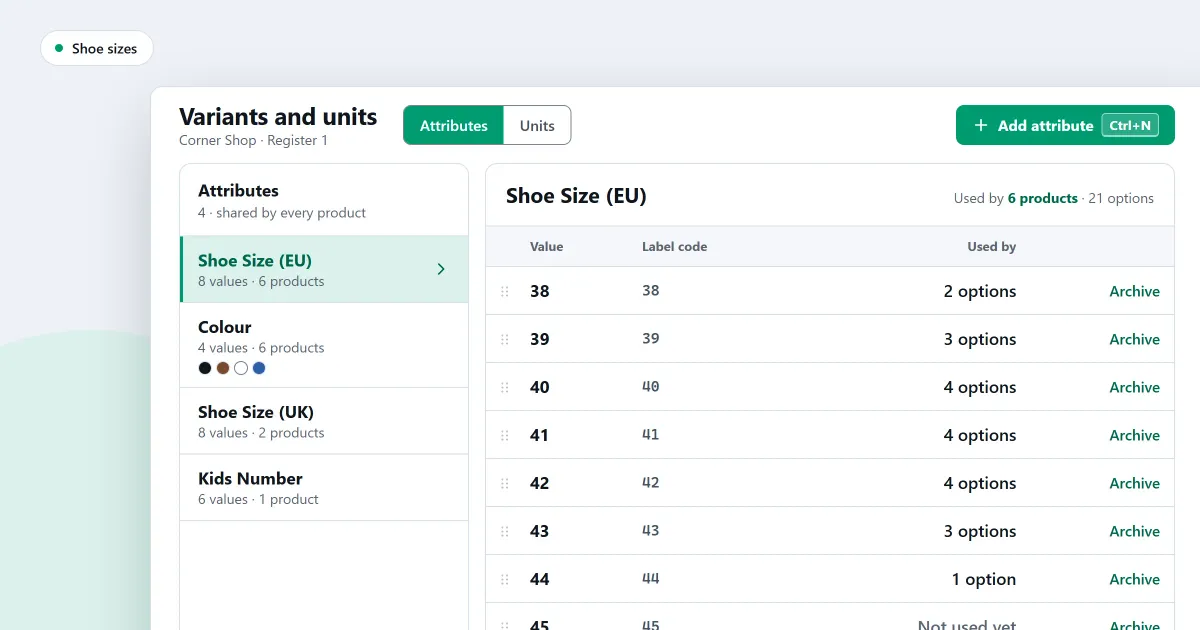
How do you open a shoe shop without a pair in the wrong size on the shelf and the right size sold out? A shoe shop sells one style in many sizes and colours. Every pair is a separate line of stock, and a customer may come back the next week to swap a pair. This checklist covers the choices to make before the first day. The last part shows where SellyPOS stands for each one, and which edition holds it.
What does a shoe shop need to plan first?
Before a shoe shop opens, plan the styles you stock, the size run for each style, and the colours. Decide the exchange rule before the first customer, so the counter knows what to do. A shop that plans its size run first avoids a shelf full of one size and none of another.
- Styles. List each style, and the price band it sits in.
- Size run. Decide the sizes each style carries, and how many pairs of each size you start with.
- Colours. Decide the colours each style comes in, and buy by colour as well as by size.
- Exchanges. Write the exchange rule down in plain words, and show it at the counter.
- Returned pairs. Decide where a returned pair goes: back on the shelf, into a separate place for checking, or out of stock.
- The season. Decide when a season’s stock is reduced, and how it is sold off.
How many pairs of each size should a shoe shop start with?
A shoe shop should start with more pairs of the sizes that sell most, and fewer of the rest. A size that sells out early is a size to order again. Count each size and colour by pair, and write the count down, so the next order is based on what sold rather than on memory.
Here is a worked example with invented sizes and figures. A style arrives with 12 pairs, 3 in each of four sizes. In the first week the shop sells 3 pairs of size 40 and 1 pair of size 42.
| Size | Arrived | Sold in week one | Left |
|---|---|---|---|
| 40 | 3 | 3 | 0 |
| 41 | 3 | 0 | 3 |
| 42 | 3 | 1 | 2 |
| 43 | 3 | 0 | 3 |
| Total | 12 | 4 | 8 |
Size 40 has sold out, so the next order should add it. Size 41 has not sold, so it can wait.
How do exchanges work in a shoe shop?
A shoe exchange swaps a pair for another size or colour. The difference is paid, or refunded when the new pair costs less. SellyPOS does this in one sale, with the returned pair and the new pair on the same sale. Set your exchange rule first, so the cashier applies it the same way each time.
Keep a returned pair apart until you know it can be sold again. The return reason decides whether the pair goes back on the shelf, is held in quarantine or is written off, so choose the reason with care.
Where SellyPOS stands
- Shoe options at setup. Choose Shoes as the business type at onboarding, or correct the type later in Setup, and the options are created. Basic and Professional.
- Sizes and colours as a grid. A product’s variants can be shown as a grid of size against colour, with the stock of each. Each variant keeps its own barcode, price and stock. Basic and Professional. See how to set up sizes and colours for a product and the sizes and colours section.
- Picking a product. On purchase orders, goods received, quick purchase and stock adjustments, picking a product with variants adds a line for each active variant, with no quantity. Picking one variant adds only that one. Basic and Professional.
- The variant at the counter. Type the name of a product that has variants, and the counter asks which one you mean, on a list that shows each variant’s availability. A scanned variant barcode goes straight to its own variant. Basic and Professional.
- Exchanges. A customer can return goods and take replacements in the same sale, and the difference is paid or refunded. Lite, Basic and Professional. Exchanges are not read by any report yet. The returns and exchanges page explains the rest.
- Store credit instead of money back. When money back is off and store credit is on, an exchange that would give money back gives store credit instead. If both are off, the exchange is refused. Professional only.
- Size labels. A size label prints only the short code of the size, such as M or XL. You choose which attribute a size design reads, so a shoe design and a shirt design can differ. Professional only.
- Promotions. A promotion is entered with a name, a percentage or amount off, and its days, then the products are chosen. Professional only.
The shoe shop POS software page goes further on sizes and colours. Lite holds up to 20 products, so a shoe shop with a full size run needs Basic or Professional.
Next
Read how to set up sizes and colours for a product and how to exchange items in one sale. For the clothing side of the same questions, read the checklist for garment shop software. Compare the editions on the pricing page, or download SellyPOS.
Questions people ask
Do I have to add every size of a shirt one at a time?
No. On purchase orders, goods received, quick purchase and stock adjustments, picking a product with variants adds a line for each active variant, with no quantity. Picking one variant adds only that one. Stock that sits on no variant can be given to the variants in the Distribute stock window, or adjusted out with an ordinary stock adjustment. A size label prints only the short code of the size, such as M or XL. You choose which attribute a size design reads, so a shirt design and a shoe design can differ. Choose garments or shoes as your business type at setup, or later in Setup, and the variant options are created for you. See POS software for clothing stores.
